
Teen Patti AK47: Rules for the Fixed Wild Card Variant
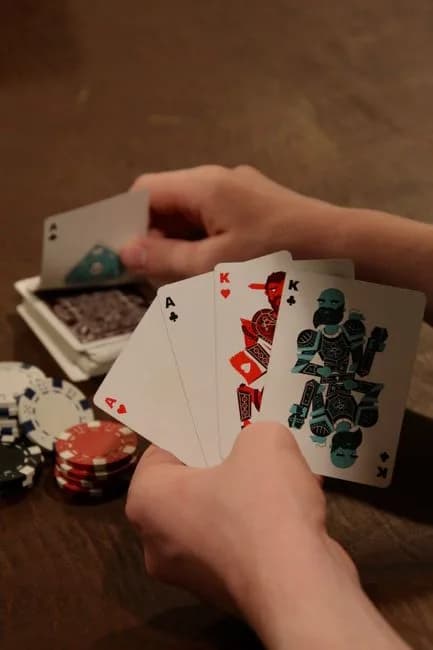
Teen Patti AK47 makes every Ace, King, 4, and 7 in the deck permanently wild for the entire game, rather than selecting one wild rank per round like the standard Joker variant, resulting in 16 of 52 cards acting as wild cards at all times.
Most players who've tried the standard Joker variant assume they already understand how wild cards work in Teen Patti — one rank gets chosen each round, and it's wild for that hand only. Teen Patti AK47 throws that assumption out. Instead of one wild rank chosen fresh each round, four ranks are wild for the entire game, every round, with no re-selection at all: Aces, Kings, 4s, and 7s.
This article is a deep dive on exactly that: how the fixed wild-card set works, what it means for how often strong hands show up, worked examples, and how it should change your strategy compared to both classic Teen Patti and the standard Joker variant. If you haven't read our classic Teen Patti rules guide yet, start there for the base deal and betting mechanics, which AK47 doesn't change at all. For contrast with the single-rank wild card system, our Teen Patti Joker variant guide covers that version in detail. And if you want the wider comparison across all five named variants at once, see our Teen Patti variants overview.
Where the Name Comes From
"AK47" is simply a memorable way to name the four wild ranks: Ace, King, 4, and 7. It has nothing to do with the actual firearm beyond borrowing a catchy, easy-to-remember label — a naming pattern common in home-game variant names generally. Once you know the name refers to those four specific ranks, the rest of the rule is straightforward to state: every Ace, King, 4, and 7 in the deck is wild, for every player, for every hand, all game long.
Fixed Wild Cards vs. the Standard Joker Variant
This is the single most important distinction to get right, because it's easy to conflate AK47 with the standard Joker variant if you only skim the rules.
In the standard Joker variant, one rank is chosen at random each round — commonly by cutting the deck or dealing an extra card face-up — and only that rank is wild, only for that round. Next round, a different rank might come up.
In AK47, there is no round-by-round selection at all. The same four ranks — A, K, 4, 7 — are wild in every single hand from the first deal to the last, for the entire session. Nothing is re-drawn or re-cut to determine the wild ranks; they're fixed by the variant's name itself.
The practical effect is a much larger number of wild cards in circulation. A standard deck has 52 cards. In the Joker variant, four cards are wild in any given round (the four cards of whichever single rank was drawn). In AK47, sixteen cards are wild at all times — four ranks (A, K, 4, 7) times four suits each. That's roughly 31% of the entire deck acting as a wild card, compared to roughly 7.7% (4 out of 52) in a single-rank Joker round.
Flag on variance: the specific four ranks used (A, K, 4, 7) are what the name "AK47" is built around, and this is the standard, widely recognized version of the variant. That said, as with every home-game-originated Teen Patti variant, some apps or tables have been known to run modified versions with different fixed ranks under a similar name, so it's worth double-checking a specific platform's rules page rather than assuming the exact four ranks without confirming.
Worked Examples
Example 1: A Weak-Looking Hand Becomes a Trail
5♠ 4♦ 7♣
At first glance this looks like a bare high card hand — 7-high, nothing connected. But both the 4♦ and 7♣ are wild under AK47 rules. You can declare both as 5s, turning the hand into:
5♠ 5♦ (wild) 5♣ (wild) — a trail of 5s, the strongest hand category in the game, built from what looked like a throwaway hand at first read.
Example 2: Building a Pure Sequence With One Wild Card
A♠ 9♠ 8♠
The Ace here is wild. All three cards are already spades, so declaring the Ace as a 10♠ gives you:
10♠ (wild) 9♠ 8♠ — a pure sequence, and since all three cards are spades throughout, it stays "pure." One wild card was enough to upgrade a color into the second-strongest hand category.
Example 3: Two Wild Cards, Maximum Flexibility
K♦ 4♣ 9♥
Both the King and the 4 are wild here, leaving only the 9♥ as a fixed card. With two wild cards and one fixed card, you have enormous flexibility — you could declare both wilds as 9s for a trail of 9s, or build toward a pure sequence if the suits allowed it. In practice, with only one genuine card locked in, most players will simply take the trail, since it's the strongest category and the most straightforward result.
Example 4: When Wild Cards Don't Save a Hand
A♠ K♦ 2♣
Even though both the Ace and King are wild, the fixed card here is a lone 2♣. Two wild cards plus one fixed card can always be turned into at least a trail (declare both wilds as 2s), so this hand is actually a trail of 2s once you use the wilds correctly — a reminder that having wild cards doesn't automatically mean a weak trail; it usually means at least a trail is achievable, given any two wild cards can match the third.
How This Changes Strategy
The Bar for "a Good Hand" Rises Sharply
With 16 of 52 cards acting as wild, trails and pure sequences are dramatically more common at an AK47 table than in classic Teen Patti or even the standard Joker variant. A hand that would be a clear value bet in classic Teen Patti — a decent pair, for instance — needs to be treated with real caution here, because the odds that an opponent is sitting on a wild-card-boosted trail are meaningfully higher than in almost any other format on this site.
"Genuine" Hands Without Wild Cards Gain Relative Value
Here's the counterintuitive part: because trails and pure sequences become common, a hand made entirely of non-wild cards — say, a solid pair built from three "normal" ranks like 6, 9, and Jack — can actually be read more confidently by opponents as exactly what it looks like, since there's no wild-card ambiguity attached to it. Some experienced AK47 players specifically favor these "clean" hands for value bets, since opponents can't suspect a hidden wild-card upgrade behind them the way they would with a hand containing an Ace, King, 4, or 7.
Card Counting Matters More Here Than in Joker
Because the wild ranks never change round to round, tracking how many Aces, Kings, 4s, and 7s have already appeared (your own hand, folded hands shown at side show, and cards visible from earlier rounds if the platform shows them) gives you a genuine edge on estimating how many wild cards remain live in the deck. This kind of tracking is far less useful in the standard Joker variant, where the wild rank resets every round and any counting resets with it.
Adjust Bet Sizing Upward for Caution, Not Just Aggression
New players sometimes read "way more wild cards" as "bet bigger, more often," but the correct adjustment cuts both ways: you should bet more confidently with hands that use wild cards well, but you also need to fold hands you'd have called in classic Teen Patti, since the baseline strength needed to win a showdown is simply higher across the whole table.
Common Misunderstandings About AK47
A few mix-ups show up regularly among players moving from classic Teen Patti or the standard Joker variant into AK47:
Assuming AK47 is "just Joker with more wild cards." The mechanics are related, but the fixed, unchanging nature of the four wild ranks is a meaningfully different structure from a rank that resets every round, and it supports different strategic habits like card counting.
Forgetting that all four suits of each wild rank count. It isn't just one Ace, one King, one 4, and one 7 that are wild — every suit of each of those four ranks is wild, which is where the full sixteen-card count comes from.
Treating any hand with an Ace or King as automatically strong. An Ace or King being wild only helps if the rest of the hand can be shaped into something better; a hand with two wild cards and one weak, unhelpful third card still needs that third card to cooperate.
Underestimating how often opponents hold at least a trail. Because at least a trail is achievable with just two wild cards and any matching third card, experienced AK47 players fold hands they'd have called in classic Teen Patti far more readily.
Where to Go Next
For the base rules AK47 builds on, see our classic Teen Patti rules guide. To understand the contrast with a single re-selected wild rank rather than four fixed ones, our Teen Patti Joker variant guide walks through that version in full. And for a side-by-side look at AK47 against Muflis, 999, Jackpot, and the standard Joker variant, our Teen Patti variants overview covers all five together.
AK47 is the variant where wild-card math matters most — with roughly a third of the deck acting as wild cards at all times, treating it like a slightly-bigger version of the standard Joker variant is a mistake that costs real money at the table. For background on the broader Teen Patti game family this variant belongs to, see the Wikipedia page on Teen Patti.
AK47 vs Standard Joker vs Classic Teen Patti
| Aspect | Classic Teen Patti | Standard Joker | AK47 |
|---|---|---|---|
| Wild cards | None | 1 rank, re-selected each round | 4 fixed ranks (A, K, 4, 7), every round |
| Wild cards in deck | 0 | 4 of 52 (~7.7%) | 16 of 52 (~31%) |
| Selection method | N/A | Cut the deck or extra card, varies by app | None — fixed by the variant itself |
| Strong hand frequency | Baseline | Elevated | Sharply elevated |
| Card counting value | Low | Low (resets each round) | Higher (ranks never change) |
Test Your Wild-Card Reads in AK47
See how your strategy holds up when a third of the deck is wild — play Teen Patti AK47 for real stakes on UU7GAME.
Play on UU7GAMEFrequently Asked Questions

Written by
Rohan KapoorReviews & Trust Editor
Rohan covers platform reviews, bonus terms, and payments and security topics for UU7 and checks every platform claim against its own published terms before it goes to print.
Related Reading
 Game Guides
Teen Patti Joker Variant: Rules and How Wild Cards Change the Game
How the Teen Patti Joker variant selects its wild rank each round, how jokers upgrade weak hands into trails, and how the wild card should change your strategy.
 Game Guides
Teen Patti Muflis: Rules for the Lowest-Hand-Wins Variant
Teen Patti Muflis reverses every hand ranking so the lowest hand wins. See the full reversed ranking order, worked examples, and how to relearn strategy.
 Game Guides
Teen Patti Variants Explained: Joker, Muflis, AK-47, 999 and Jackpot
A clear guide to the most popular teen patti variants - Joker, Muflis, AK-47, 999 and Jackpot - and how each one changes strategy and hand strength.
 Game Guides
Teen Patti Rules and Strategy for Beginners
Learn teen patti rules from hand rankings to blind, seen, chaal, and side show betting moves, plus beginner strategy tips for smarter, more disciplined play.