
Classic Teen Patti Rules Explained: The Original Format
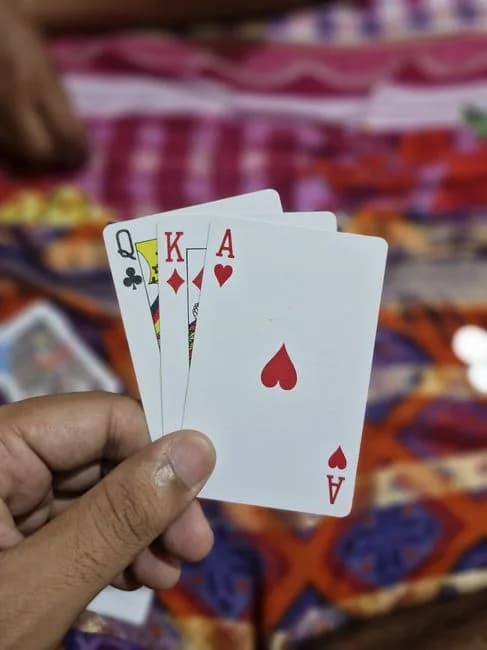
Classic Teen Patti uses a standard 52-card deck with no wild cards. Three cards are dealt to each player, betting alternates between blind and seen (chaal) wagers, and the strongest hand follows a fixed order: trail, pure sequence, sequence, color, pair, then high card.
Most players learn Teen Patti through whichever variant their friends or app happen to be running — Joker, Muflis, AK47, or one of the dozens of house-rule twists that have spread through home games and apps over the years. Fewer players ever sit down with the plain, no-wild-card, no-twist version that everything else is built on top of.
That plain version is what this article covers. If you want the wide-angle view comparing all the major variants side by side, read our Teen Patti variants overview first. This piece does the opposite: it stays entirely inside the original, no-variant format and goes deep on exactly how the deal, the betting, and the hand rankings work, with worked examples for every hand type. Once this baseline is solid, every variant is just "classic Teen Patti, plus one specific rule change" — which is why we're treating this as the foundation post the others link back to.
What "Classic" Means Here
Classic Teen Patti — sometimes called "no wild card" or "simple" Teen Patti — uses a standard 52-card deck, no jokers, no reversed rankings, and no fixed wild ranks. Three cards are dealt to each player, and the best three-card hand at showdown (or the last player standing after everyone else folds) takes the pot. Every other variant — Joker, Muflis, AK47, 999, Jackpot — starts from this exact structure and then changes one specific thing about it. Learn this version properly and every variant becomes a one-paragraph mental patch rather than a whole new game.
Teen Patti itself has a long history as a South Asian adaptation of the British card game Three Card Brag, and its structure — three cards, blind betting, a fixed hand-ranking ladder — has stayed remarkably stable across regions even as house rules and variant names multiplied. For more background on its origins and spread, see the Wikipedia entry on Teen Patti.
The Deal
Before any cards are dealt, every player contributes a fixed amount to the pot. This is called the boot amount, and it sets the table stakes for that hand — a small boot means small early bets, a large boot means the pot starts heavier.
Once the boot is collected, the dealer deals three cards face down to each player, one at a time, going clockwise. No cards are shown, no cards are exchanged, and nobody draws additional cards later — whatever three cards you're dealt are the three cards you play the entire hand with. This is a fixed-hand game, not a draw game.
Play then moves clockwise starting with the player to the dealer's left. Each player, in turn, decides whether to bet and stay in the hand or fold and forfeit whatever they've put in so far.
Blind Betting vs Seen Betting
This is the part of classic Teen Patti that trips up newer players, so it's worth walking through carefully.
At any point before showdown, a player is in one of two states:
Blind — the player has not looked at their own cards. They are betting purely on position and read of the table.
Seen — the player has looked at their cards (sometimes called playing "chaal") and is now betting with information.
The core betting rule is that a seen bet is worth more than a blind bet of the same chip amount, because seeing your cards is an advantage. In most tables and apps, the convention works like this:
A blind player can bet an amount equal to the current stake (the standing bet level for that round) without looking at their cards.
A seen player, once they look, must bet at least double the current stake to stay in — this is the "chaal" bet.
Any player, blind or seen, can also raise beyond the minimum, which increases the current stake for everyone still in the hand.
So if the current stake is ₹10: a blind player can call for ₹10, while a seen player calling for the first time typically has to put in ₹20. This is why players often stay blind for several rounds early in a hand — it's cheaper to stay in without information than to look and pay double.
Flag on variance: the exact multiplier (2x for seen bets is the most common convention), whether stakes are capped at a maximum, and how quickly the stake is allowed to double are all things that differ by table and by app. Some platforms cap the number of raises per hand; home games often don't. Always check the specific room's rules before assuming the multiplier — the "double for seen" convention described above is the most widely used, not a universal law.
Side Show (Sideshow)
A side show is a request one seen player can make to another seen player, asking to privately compare hands to decide who folds, without involving the rest of the table. A few conditions generally apply:
Both players involved must be seen (a blind player can't be asked for or request a side show).
The requesting player must be next in turn after the player they're asking.
There need to be at least three active players remaining in the hand — a side show isn't available heads-up, since at that point it's just a normal showdown.
The player being asked can decline the side show request entirely, in which case play continues normally.
If the side show is accepted, the two players compare hands privately: the weaker hand must fold, and the stronger hand continues in the game against the remaining players. This doesn't end the hand — it just removes one player without the rest of the table seeing either card set.
Side show mechanics are another area with real variance between apps — some digital platforms simplify or remove side show entirely, while home games often use it heavily as a tool to thin the field cheaply. Treat the version above as the common baseline, not a fixed rule everywhere.
Hand Rankings in Classic Teen Patti
This is the ranking order every variant either uses directly or deliberately inverts/modifies. From strongest to weakest:
1. Trail / Trio (Three of a Kind)
Three cards of the same rank. This is the highest possible hand in classic Teen Patti. Ranked by card value, with three Aces (A-A-A) as the highest trail and three 2s (2-2-2) as the lowest.
Example: Q♣ Q♦ Q♠ beats 9♥ 9♣ 9♦, but loses to K♠ K♥ K♦.
2. Pure Sequence (Straight Flush)
Three consecutive cards, all the same suit. The most commonly used ranking treats A-K-Q as the highest pure sequence and A-2-3 as the lowest, since the Ace can sit at either end of the run but the sequence doesn't wrap around past King.
Example: A♠ K♠ Q♠ is the strongest pure sequence possible. 4♣ 3♣ 2♣ is a mid-low pure sequence. A♥ 2♥ 3♥ is the weakest pure sequence.
3. Sequence (Run)
Three consecutive cards, not all the same suit. Same rank order as pure sequence (A-K-Q highest, A-2-3 lowest), just without the suit-matching requirement.
Example: A♠ K♦ Q♣ is a sequence but not a pure sequence, because the suits don't match.
4. Color (Flush)
Three cards of the same suit, not in sequence. Ranked first by the highest card, then the second-highest, then the third if needed.
Example: K♠ 9♠ 4♠ beats Q♥ J♥ 8♥, because the King outranks the Queen even though both are non-sequential same-suit hands.
5. Pair
Two cards of the same rank plus one unmatched card. Ranked first by the pair's rank, then by the kicker card if two players share the same pair rank.
Example: Q♣ Q♦ 7♠ beats J♥ J♦ A♣, because a pair of Queens outranks a pair of Jacks regardless of the kicker.
6. High Card
None of the above. The weakest hand category, ranked by highest card, then second, then third.
Example: A♦ J♣ 6♥ beats K♠ 9♥ 4♣, because the Ace outranks the King as the top card.
Flag on variance again: almost every reputable source agrees on this six-tier order and on trail being the top hand — that part is very stable across apps and regions. The one detail that occasionally shifts is exactly which sequence is labeled "highest" (A-K-Q vs. treating Ace strictly as high with no low-Ace run at all). If a specific app's rules page states a different sequence ranking, follow that app's stated rule for real-money play — this article describes the generally accepted version, not a single universal standard.
Why Classic Rules Are the Right Place to Start
Every named variant is a modification layered on top of everything above:
Joker variant keeps the same six-tier ranking order but adds a wild card that can substitute for any card, changing how often strong hands appear. See our full breakdown of the Joker variant in the overview post.
Muflis keeps the same deal and betting structure but flips the ranking order upside down, so the weakest hand wins.
AK47 keeps everything from classic rules except it makes four specific ranks permanently wild for the entire game.
999 and Jackpot each add their own specific twist on top of this same base.
Because the deal mechanics, boot structure, blind/seen betting, and side show rules are shared across almost every variant, the only thing that actually changes from one variant to the next is usually the hand-ranking table or the wild-card rule. Once you know classic Teen Patti cold, learning a new variant is mostly a matter of memorizing one exception rather than relearning the whole game.
Common Mistakes New Players Make
Confusing "sequence" with "pure sequence." A run needs the same suit to be "pure" — mixed-suit runs are a separate, weaker category.
Assuming blind and seen bets cost the same. They don't in the standard convention; seen bets typically cost double.
Thinking a pair always beats a color. It doesn't — color (flush) outranks pair in the standard ranking.
Treating side show as a right rather than a request. The player being asked can always decline.
Where to Go Next
If you're new to real-money Teen Patti generally and want the full picture on getting started — deposits, table selection, basic etiquette — our guide on how to play Teen Patti online for real money covers that ground. For strategy that builds on the rules covered here — when to stay blind, when a side show is worth requesting, how to size seen bets — see our Teen Patti rules and strategy guide. And if you came here to compare variants rather than go deep on the original format, the Teen Patti variants overview is the better starting point.
Classic Teen Patti is deliberately simple: three cards, one ranking ladder, and a betting structure built around the blind/seen information gap. Every variant this site covers separately is easier to pick up once this base version is second nature.
Ready to Put These Rules Into Practice?
Take what you've learned about classic Teen Patti straight to the tables and play for real stakes on UU7GAME.
Play on UU7GAMEFrequently Asked Questions

Written by
Arjun MehtaGame Strategy Writer
Arjun writes UU7's rummy, teen patti, slots, aviator, and live casino strategy content, with a focus on getting the rules exactly right and keeping advice practical rather than hypey.
Related Reading
 Game Guides
Teen Patti Rules and Strategy for Beginners
Learn teen patti rules from hand rankings to blind, seen, chaal, and side show betting moves, plus beginner strategy tips for smarter, more disciplined play.
 Game Guides
Teen Patti Variants Explained: Joker, Muflis, AK-47, 999 and Jackpot
A clear guide to the most popular teen patti variants - Joker, Muflis, AK-47, 999 and Jackpot - and how each one changes strategy and hand strength.
 Game Guides
Teenpatti 20-20 Guide: Rules, Format, and Strategy
Learn how Teenpatti 20-20 works with this complete guide covering the shared-outcome betting format, hand rankings, strategy tips, and how it compares.
 App Tutorials
UU7GAME Teen Patti Guide
Learn how to play Teen Patti on UU7GAME with this complete guide covering rules, hand rankings, all game variants, table stakes, strategy tips, and bonuses.